If you are going to launch a singing career in K-pop or J-pop, I guess YouTube and 4 iPhones is a good a way as any. The amount of time people spend on publishing on YouTube is really incredible.
Search

Custom Search
Thursday, September 23, 2010


Tuesday, September 21, 2010
EpicMix: Skiing + RFID+ badges + achievements = fun
This is intensely cool. I'm trying to think of another example of where product innovations in video games and mobile LBS games were brought back out of the virtual into reality to make something better. I think EpicMix is genius, and it's going to be fun.
By adding game mechanics to their season ski passes, if it works as advertised, I am certain they will sell more season passes, which will sell more concessions and generally increase attendance at Vail Resorts throughout the year.
With your RFID enabled season pass most of the Vail Resorts, that is Keystone, Breck, Vail, Beaver Creek, and Heavenly,
 you can ski or board around the mountain and earn badges for things like riding certain lifts a number of times, skiing at night, and boarding a certain distance in a specified time.


 In essence, they've married Foursquare/Gowalla badges with PS3/Xbox 360 achievements and brought them back into the real world to enhance the experience.
Of course, you can setup your account so that it automatically posts to Facebook and/or Twitter when you earn these badges, and there are both iPhone and Android mobile apps to check your progress as you move around the mountain.
I look forward to trying this out and posting the results this Winter.
By adding game mechanics to their season ski passes, if it works as advertised, I am certain they will sell more season passes, which will sell more concessions and generally increase attendance at Vail Resorts throughout the year.
With your RFID enabled season pass most of the Vail Resorts, that is Keystone, Breck, Vail, Beaver Creek, and Heavenly,

Of course, you can setup your account so that it automatically posts to Facebook and/or Twitter when you earn these badges, and there are both iPhone and Android mobile apps to check your progress as you move around the mountain.
I look forward to trying this out and posting the results this Winter.
Thursday, September 16, 2010
the first FeedBurner office

Prompted by Rick Klau, I was tired of not being able to access all my photos on Flickr every year when my pro account lapsed, so I decided to ante up one...more...time so I could have them on my own servers as well as other places in the cloud.
Man, there's a lot of gems in there, including this picture of the first FeedBurner office, snapped with a crappy Motorola cameraphone.
Of course, that was a "cameraphone" - what a silly word now. Doesn't every phone have a camera now?
The most valuable real estate on OldTwitter, and why it's important to NewTwitter
My Twitter account hasn't been upgraded yet, so I haven't been able to look at the "#NewTwitter" but in absence of that I'd like to comment on my what I think is the most valuable web real estate Twitter has in the old Twitter.
It's the dialog that comes up after a user clicks the official Tweet Button:

There's a few reasons I like this dialog and think it's smart in the way it is designed compared to some of it's ilk, and really think Twitter will benefit from this button, the fact that it seems to be getting more use notwithstanding.
Specifically I like it because:
1. The user has just finished an action - that is, reading a story, and decided to share it - so the chance they will begin a new action is greater than if they were in the middle of reading that story and doing anything else.
It's the dialog that comes up after a user clicks the official Tweet Button:
There's a few reasons I like this dialog and think it's smart in the way it is designed compared to some of it's ilk, and really think Twitter will benefit from this button, the fact that it seems to be getting more use notwithstanding.
 |
| On Techcrunch, posts are always tweeted more than buzzed, liked, or dugg. |
Specifically I like it because:
1. The user has just finished an action - that is, reading a story, and decided to share it - so the chance they will begin a new action is greater than if they were in the middle of reading that story and doing anything else.
Because they have the user's undivided attention here, the chance the user will execute the "conversion", which in this case is to follow the publisher from which this story came, is greater than average. Another way to say this is if you consider this an "ad" to follow this publisher, I think there's a good chance it will get a click.
Applications that can take traffic from Google Search and turn it into something else, tend to do pretty well. Look no further than Google AdSense for content as an example.
So where does this all go?
Well, if you view Twitter as both an underlying protocol and an application that will use that protocol that will help "level the playing field between creators and consumers of content" we can see the value Twitter thinks they get by easily providing a way for these publishers to reach these consumers. The more of these creator/consumer relationships they create, the better.
I will also mention though, that although "you don't need to tweet to get value from Twitter" - there are indeed a lot of people tweeting and it's important that they continue to do so, so that they can be in the very same environment as the content publishers, and the pure content consumers. In fact, the "tweeters" are the ones that need to be the foundation of the content consumers.
This allows Twitter down the line to offer advertising in #NewTwitter (revenue share TBD) and also, perhaps more importantly, push their own search, and sell their own search advertising. If you are converting search users to followers, and they are spending more time in the NewTwitter, then you begin to have a chance to compete for that small section of search traffic that is looking for what is happening now.
In the "economy of attention" - every little bit of time spent on the platform helps, and that's what this dialog does - gets consumers to incrementally spend more time on this platform, and less time in others - such as Facebook and any other future platforms that may start competing for user's attention.
Of course, this is all conjecture, but it's fun to get out the crystal ball and make predictions nonetheless.
Most people think that internet ads are all pretty much the same, but the reality is that there is actually a huge difference in how an ad performs that is dependent on the intent of what the user is doing at that very moment. Many display advertisers that put their medium rectangles in the middle of content don't actually expect you to click on that ad, but just see their brand and campaign while you are reading. Search advertisers, on the other hand, know you are "ready to buy" and thus advertise accordingly on search result pages.
These are relevant and at an attention break, so I think they will work.
2. This dialog is converting transient search users to followers, and a follower is worth more to the publisher (and Twitter) than a transient search user.
Why? If a publisher is in the game of tracking their CPM for the ads on their page, a search user is registering 1 impression, while the chance that a follower will see more than 1 impression over time will be pretty great, because now this publisher is pushing many links per day at this user into their timeline.
In this case above, I had never really heard of Amp Magazine, but I found them via a Google Search, and seeing they have some pretty cool content chose to follow them. Now I get a whole lot more content.
Applications that can take traffic from Google Search and turn it into something else, tend to do pretty well. Look no further than Google AdSense for content as an example.
So where does this all go?
Well, if you view Twitter as both an underlying protocol and an application that will use that protocol that will help "level the playing field between creators and consumers of content" we can see the value Twitter thinks they get by easily providing a way for these publishers to reach these consumers. The more of these creator/consumer relationships they create, the better.
I will also mention though, that although "you don't need to tweet to get value from Twitter" - there are indeed a lot of people tweeting and it's important that they continue to do so, so that they can be in the very same environment as the content publishers, and the pure content consumers. In fact, the "tweeters" are the ones that need to be the foundation of the content consumers.
This allows Twitter down the line to offer advertising in #NewTwitter (revenue share TBD) and also, perhaps more importantly, push their own search, and sell their own search advertising. If you are converting search users to followers, and they are spending more time in the NewTwitter, then you begin to have a chance to compete for that small section of search traffic that is looking for what is happening now.
In the "economy of attention" - every little bit of time spent on the platform helps, and that's what this dialog does - gets consumers to incrementally spend more time on this platform, and less time in others - such as Facebook and any other future platforms that may start competing for user's attention.
Of course, this is all conjecture, but it's fun to get out the crystal ball and make predictions nonetheless.
Monday, September 06, 2010
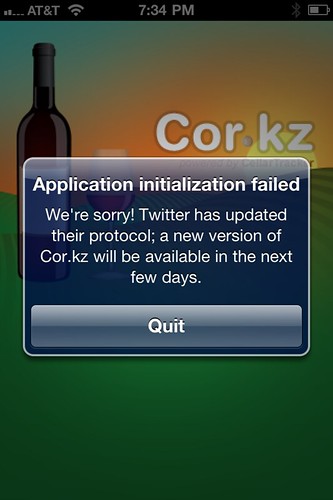
Thursday, September 02, 2010
Why Flipboard and Twitter for iPad are profoundly significant
I think Flipboard is absolutely fantastic. Every day when I pick up my iPad, it's continually the application I always look at first. Previously, and before the release of Flipboard, I wrote about how news on the iPad was innovating on presentation and Flipboard does this and more at a personalized level.
Yesterday, Twitter released the newest rev of their iOS client, Twitter for iPad, which also does a lot of innovative things, while still keeping the feel of a "traditional" Twitter client. I doubt I'll be picking up my iPad much without spending a few minutes inside the app.
But Flipboard and Twitter have done something else more profound that may not be obvious to the average user:
Yesterday, Twitter released the newest rev of their iOS client, Twitter for iPad, which also does a lot of innovative things, while still keeping the feel of a "traditional" Twitter client. I doubt I'll be picking up my iPad much without spending a few minutes inside the app.
But Flipboard and Twitter have done something else more profound that may not be obvious to the average user:
- The apps reinforce something that I've thought for a long time, that Twitter is really just a protocol; a 140 character packet with a payload. It will eventually get pushed down the stack just like RSS has been, becoming the infrastructure that exists for publishers to connect with subscribers .
- These apps highlight some of the differences between the Twitter/Social ecosystem and the RSS/feed reading ecosystem, the largest one being that in the RSS ecosystem, the publisher was king, but in the Twitter ecosystem, the user is king.
Let me explain a little more what I mean by these statements.
To the large majority of Twitter's users, the platform is an ego based application that allows them to broadcast to the world what they are thinking right now. The interact directly in the bounds of the medium which is a 140 character text message. For a large number of users, they interact directly with this 140 character message at one level above the protocol level, that is, an application that reads and displays those 140 characters.
Now, this isn't that much difference than how RSS was traditionally used, except this 140 character limit doesn't exist in RSS. You can put as much content as you want in an RSS message. However, users of RSS rarely interacted directly with the protocol at on the publishing side, though they certainly did on the subscriber side, that is an RSS reader that pretty much displayed the content of the RSS description field. On the publishing side, users usually use a blogging platform to create content, and this is reformatted as RSS usually through some type of software adaptor in the blogging platform.
Now, because of this 140 character limit in Twitter, developers quickly figured out how to encode the same types of content that they might have with a blogging platform, that is in a URL, and more specifically a shortened URL to allow for as much text metadata along with that message as possible. This made it possible for "publishers" - those sites like New York Times and mega-bloggers like Techcrunch to also distribute stories using Twitter, again, encoded in a shortened URL.
 |
| The Twitter web client, with encoded URLs |
However, for users acting directly at the protocol level, this is a bit of messy experience. You essentially have to leave the application by clicking on the embedded URL, and let your browser go somewhere else to decode the content of the message. If I learned anything from working with millions of RSS users over the last few years: they will leave their reading application if they have to, but they generally don't like to.
 |
| Brizzly Twitter client, showing destination URLs |
Brizzly, pictured above, was one of the first clients to start to "unpack" these shortened URLs and show the user where they might go by displaying destination URLs, and in cases of photos, even go fetch and embed those photos. [disclosure: I am an investor in ThingLabs, which makes Brizzly]
 |
 |
| Twitter for iPad |
Flipboard and Twitter for iPad take this a bit further, by actually fetching and displaying the encoded content encoded in the shortened URL in the large majority of the cases.
Suddenly, as a user, you aren't interacting at the protocol level at all, but interacting with the content that the original publisher wanted you to interact with, all without leaving the application in which the user is consuming the content. These applications, though the presentation is certainly prettier, are starting to have a lot in common with popular RSS readers, but are also doing a lot more just as a function of the application platforms that allow some richer experiences.
But there's something more profound going on here - and why the Twitter ecosystem is different from the RSS ecosystem is that we've seen a fundamental shift from the publisher being in control to the user and the delivery platform being in control.
In the RSS ecosystem, if a publisher wanted their content to be displayed in 140 character chunks (and many did and still do through partial feeds) that was the way it had to be displayed. There were feed readers that tried to go fetch and essentially "unpack" this content, but when they did, publishers screamed bloody murder that these feed readers were "stealing" their content. If a feed reader tried to monetize themselves without giving the publisher a cut, again, publishers generally tried to make sure these feed readers failed. You wouldn't believe the number of publishers that constantly asked FeedBurner to provide a way for them to block their content from being delivered to specific feed readers, because they didn't like the way it displayed their content. The publisher was king and the ecosystem generally listened.
In the Twitter ecosystem, this type of sentiment has never really been allowed to exist, possibly because usage reached the tipping point before publishers realized they absolutely had to distribute via Twitter to even continue to be viable. Twitter is going to monetize the timeline, the publishers aren't going to share that revenue, and I don't think that is going to change. Twitter apps and clients are going to monetize outside and around the timeline and I don't think that is going to change. Twitter is going to start encoding all your URLs so that they have the data on all your distribution, and I don't think that is going to change. They'll be in the position to provide this data to publishers, but have no obligation to do so.
Now, Twitter for iPad bringing in the entire page of publisher content, so the publisher is going to get ad impressions (see the ads in the FourFourTwo page above) in addition to distribution in that case. Publishers are still getting the distribution they were hoping for, even if it is no longer a "click" back to their site from the timeline.
But for sure, Flipboard is not just displaying the content that exists in the the Twitter 140 character format, and is "scraping" the content and redisplaying it. They're still showing the protocol level message, but then the content (though not always full) and the conversation around it. I think publishers will see that applications like this are scraping their content and using it, but I don't think in this ecosystem there's a damn thing they can do about it. Sure, they can stop publishing via Twitter. Good luck with that.
All the smart publishers will realize it's actually better for them to have more users engaging with their content, wherever it may be, than not engaging at all.
For the user, this is fantastic. When you marry this with a similar view of content from Facebook, arbitrary feeds, and other aggregated content sources - it's exactly what I want as a user. I can, for the most part, stay in my aggregator application and experience the real time stream in a way that totally makes sense.
If I've learned one thing from working at Google from combing through mounds of data that my job entails - when the user is king on a popular platform, the platform on which those users operate wins. The scale of internet users is always greater than the number of publishers, so when you can start adding users at exponentially high numbers you can never extract the underlying platform, for myriad reasons too long to list here.
My prediction is that while Flipboard was certainly one of the first to take this step of scraping and stitching together content, they certainly will not be the last. I think you are going to see a whole crop of innovative clients sprout up here that take advantage of what the Twitter (and other social media) ecosystem allows for. It will reach a tipping point before the traditional publishers are able to object, even though I can tell you that from all the data I have seen in the last five years, they shouldn't. More distribution means more net page views which means more revenue.
In fact, as I push the "Publish" button here in Blogger, this content is going to go within seconds to PubsubHubub to FeedBurner to FeedBurner Socialize to Twitter (and Google Reader and thousands of other places) and then guess where - right back to the page on where this content is hosted. It won't all come back here, but my analytics tools will show me that's okay, especially for a small fry publisher like myself.
Subscribe to:
Posts (Atom)
LinkWithin
