Search

Custom Search

Sunday, October 31, 2010

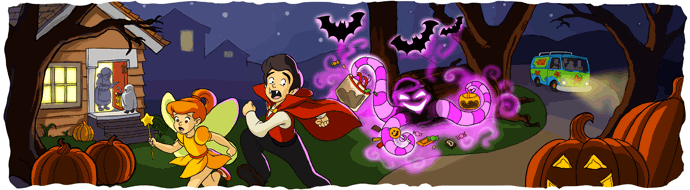
Scooby-Doo on google.com today


Halloween is by far my favorite holiday, and I still have a sentimental spot in my heart for Scooby-Doo from watching it when I was a kid.   I was happy to see these today on google.com.  I like the last one the best.

Thursday, October 28, 2010

Meta Mobile Gmail Picture

Blog post on new mobile Gmail in new mobile Gmail, posted from a mobile phone.

Sunday, October 17, 2010

I, Pork Smuggler


Those who know me know I generally don't "dig on swine" - like Jules in Pulp Fiction, not for any religious reason, but mostly just because literally went cold turkey and stopped eating most red meat long ago just because I think it's healthier. I'm not totally strict about it, like any good sushitarian can tell you, there are always exceptions.

There are only two times I really eat pork:

  1. When I am in China.   Well, I've only been to China once, but I quickly learned that ordering "Chinese Broccoli" really means "Chinese Broccoli with Pork."  They put pork in everything.  Tell them you don't eat pork and that's like telling them you don't eat rice.   They look at you like they have three heads.  Plus, those BBQ pork buns are just so tasty.
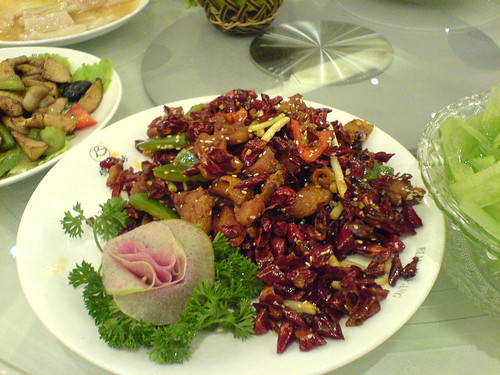
    pork and peppers
    pork and peppers


  2. When I am in Spain.  I go to Spain a lot more than I go China.  Usually once per year.  In Spain, you can easily avoid eating pork, but you would sure wonder what you are missing.  Especially in Madrid.  That's because madrileños sure do like their jamón.  They even have this chain restaurant pretty much everywhere in central Madrid called Museo de Jamón (Museum of Ham, pictured below) where you stand, eat a ham sandwich and drink a what they call a caña of beer.
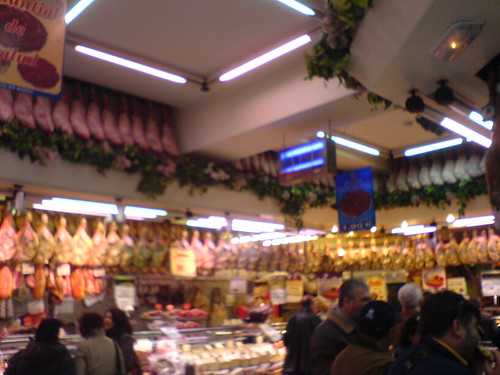
    el museo de jamon
    Museo de Jamón
Back to the story at hand.   Appetizers before a main meal in Madrid usually consist of a plate of shaved cured ham.  There are many many varieties of it, but the biggest delicacy, and also the most expensive is the ham the Spaniards call "Jamón Ibérico" or Pata Negra, which means "black leg," because the pigs apparently have black legs.

It gets better.  The best of the best Jamón Ibérico is called "Jamón Ibérico de Bellota" which essentially means Iberian Ham from Acorns.  As the Spaniards romantically tell it, these black leg pigs apparently only live in the Southwest of Spain and Southeast Portugal and they live there because they only eat the acorns from this special tree that only grows in the Southwest of Spain and Southeast Portugal.  (Actually, they totally leave out the fact that they have these pigs in Portugal as well, and I'm sure if it ever were brought up, the ones in Spain are somehow better and more exclusive.  So it goes.)

These prima donna (i guess prima doña, in this case) pigs allegedly get an acre of space each to rome around and eat these special acorns.  Anyone who has ever seen a pig before knows that pigs will eat freaking anything, so I'm guessing that's all there are to eat are these acorns.

So said another way, when you are in Spain and your guests serve you some pork from a special pig that only lives in Spain that only dines on an acorn that only grows in Spain, you eat the pig.

To make this even more exclusive, you apparently can't bring this particular pork into the U.S. without a special import license, which is difficult to obtain and comes with the right be be taxed at 100%.

Luckily, they sell tons of this stuff, vacuum packed in a box like at the top of this post at Madrid's Barajas airport.   Seems safe enough.  Surely the stuff in the duty free shop is already packaged for export to the US, no?

I get in line, with the cashier that looks remarkably similar to Penelope Cruz, and I say hello in Spanish.  She greets me back in Spanish and asks for my ticket and passport.  Seeing it's a US passport, she continues to say to me in Spanish that it's prohibited to bring the ham into the US.  I'm about 95% sure I know what she means, but I ask her back if she can sell it to in Spanish, and then if she speaks English, just so I am sure I understand.

The Penelope Cruz cashier looks at me with a sigh and says, sounding just like Penelope Cruz speaking English, "Excuse my English.  All I can say is that this is prohibited to bring into the US.   If you put it in your bag and it gets taken away, it is not our fault. Es prohibido."

"Claro.  I understand."

I make it a point to bring back Jamón Ibérico whenever I fly home through Madrid.   Nevermind that I can buy it not at Binny's liquor store a half mile from my house.   That's no fun.   It's much more fun being an international pork smugger.

Friday, October 15, 2010

How great customer service made me a programmer


My roots of being an entrepreneurial programmer date back to when I was about 12 and received a Commodore Vic-20 as a gift from my parents.  I'm pretty sure neither they nor I knew why I needed this device, but I think the thinking is that if you had a computer at that time, it would help you do better in school.  Although I don't think I really ever understood what PEEK and POKE did at the time, I became a pretty proficient BASIC programmer, mostly by programming text adventure games, with the occasional dabble into the Space Invader like games that were barely possible at that time.

However, I think the thing that pushed me over the edge was after taking one course of Pascal in college I remembered how much I liked programming and wanted to take more.  Up until that point, I had entered college thinking I was going to be an Orthodontist, so I was mainly taking pre-med classes.

At any rate, I was learning C and but kept reading up on C++ and "Object Oriented Languages" and decided I wanted to be on the bleeding edge.  So I wrote Borland a letter explaining to them that I really did want to learn C++, but I couldn't afford their compilers (I couldn't) - so if they could please make academic editions available.   A few days later I got a personal letter back from Philipe Kahn, who was CEO and founder of Borland at the time, along with a huge box of their most expensive C++ and Assember compilers at the time.  

From then on, I dove into programming with both feet.   My first class after that was Computer Graphics and although we were supposed to code in C, I asked the professor if I could code it in C++, as I wanted to use my new compilers.  To his knowledge, I was the first student to use C++ at Northwestern.

So I've kept the license card around from Borland, because I became fiercely loyal to them up until the point Philipe was pushed out and probably beyond, and it serves as a reminder of how important customer service is.

Is that a nerdy story or what?

Thursday, October 14, 2010

Amazon adds barcode scanning to iPhone app, hooks me deeper


I realized the other day that I rarely buy any "durable goods" online from anywhere except Amazon.  Especially when they hook you with Amazon Prime, why would you? (The exception is Zappos for shoes, but guess who owns them now too.)  Occasionally there are some specialty items I need to order online that Amazon  doesn't carry, but really the only other competitor for me are some brick and mortar stores.

A lot of it comes with the trust I have in Amazon to resolve any problems. In the past, I've been burnt by ordering a camera or something from one of the other online electronics retailers, only to find when the package arrives that's it's really an open box item, or even worse, reconditioned.  Then returning it is usually a huge PITA.   With Amazon Prime, I pretty much know I'll order something and it will be what I ordered, in good condition, and on my doorstep in a couple of days.

In addition, there have been multiple times I've been standing in a store, and looked the item up on my phone to price compare against Amazon.   If it's an item I'm not sure I want, it's easy enough to add to a wish list and but it later.

That's why features like this are great - more than just another feature that any mobile purchasing app should have.   They just made it a lot easier for me to find what I want and buy from them.  Good move.

Wednesday, October 13, 2010

Engaging your users with email

I forgot to mention in my quick thoughts on Summify, but was reminded by a user comment, that one of the things I liked about Summify is that they send you an email digest every day of some of the more interesting items in your stream.  I'm secretly glad I forgot, as it's worth another mentioning in a separate post.

I think in the past, too many newsreaders made the mistake of thinking "my users don't want this via email, that's why this application exists" and although that might be true for a subset of users, it certainly isn't true for everyone.

To make an obvious statement, people use different media differently.   That is, the frequency in which someone checks email is different than the frequency in which they read their Twitter stream  ( I certainly know people who check Twitter more than they check email, and I've had DM or Facebook message conversations that have replaced email - but that's not really the point).  I think generally users need to be able to decide which media alerts are interrupt driven, and which ones are meant for background occasional browsing.

For certain applications that are vying for your attention, I think engaging your users via email to spur a return to your application on an clear opt-out basis has become totally acceptable, and for me anyway, is generally preferred.   Twitter and Facebook have largely paved the way for making this the de-facto method, by alerting you via email when there are new followers or friends, or Direct Messages, and allowing you to opt-out if you don't want them. I probably wouldn't know about any of this activity if it weren't delivered by email.  I certainly wouldn't want this info delivered as a tweet itself for the Twitter examples, anyway.

Twitter notification by email


I don't think it was always this way.  It used to be considered a bit spammy to make an application email it's users without consent, but I think it's become somewhat accepted, again, as long as there is a clear opt-out of "I don't ever want to get this email again" right in the first email.

Many applications have taken the same tack with iPhone push notifications, and that's something I don't like.   I really don't want my phone beeping every time someone writes on my Facebook wall, but if I remember correctly, this is the default behavior.

The general point here is, think carefully about how to drive continued engagement with your users, and although with any notification medium you will always walk a thin line between engagement and being spammy, don't be afraid of email.  It's still the primary way most people communicate.

Monday, October 11, 2010

Quick thoughts on Summify, a simple and fast social news aggregator


Continuing the thread here of next generation of content readers, I wanted to give some brief thoughts on Summify, and browser-based newsreader that promises to algorithmically "cure your unread item guilt" by presenting you stories posted by your social networks in Twitter and Facebook, as well as meshing in your subscriptions from Google Reader.

Now, "unread item guilt" is something I never had.  I was always happy consuming feeds on the come, never being the least bit anxious about the bold black type on the left of my browser window.  But I can assure you this is not the norm.  At FeedBurner, we spent a whole lotta time making sure in the course of processing billions of feed items that we never mistakenly changed an item in a way that would mark it "unread" again in the thousands of different feed readers that calculated what made an item changed in various different ways.

There really are two types of people in the world, those who care about the unread count in their newsreaders and sane people, and although I'm kidding, anyone who subscribes to more than 100 feeds or follows more than 100 accounts on Twitter just is not going to get to read all the items that come in from that stream.

Summify tries to solve this by looking at both your items and your contacts (or friends) and presenting you a river of news, ranking on thinks like number of retweets, facebook likes and shares, and direct shares from your contact list.

It's still in private beta, so I'm guessing they haven't hit any scaling walls yet, but as of right now, the UI is very snappy and useable in a way that many ajax-heavy UIs are not, which is encouraging.

Where I've recently talked a lot about how twitter is protocol with a payload, and that we're going to start seeing a new crop of news readers that unpack this payload, Summify falls squarely into this category.   Much like Twitter for iPad, Summify unpacks short URLs in Twitter and displays a parsed version of the destination web page (or perhaps matches the content from the feed, I can't really tell) right inside Summify application.

In fact, if you only connect Summify to your Twitter account, I find it slightly more useful than #newtwitter for browsing content.

Although you can connect Summify to Google Reader and have it pull in your subscriptions from Google Reader, I don't recommend doing this right now, simply because there currently is no way to undo this.  There's a pane that clearly says this is coming soon, but if you have hundreds of feeds in Google Reader like I do, these feeds will soon overrun your Twitter stream, and frankly doesn't add a lot over using Google Reader by itself in the "Recommended Items" view.

In short though, I really like the direction Summify is going here, mostly because it's simple, useful, and fast. I think they should keep it that way and spend a lot of time keeping it fast as they scale. If it stays simple, stays useful, and stays fast, I can see this being a go to browser UI for news reading.

more adsense

LinkWithin

Related Posts with Thumbnails